
China Silk: The Ancient Textile That Wove the World Together
China and silk have been closely connected for thousands of years. Long before silk became a global symbol of luxury fashion, Chinese silk represented a remarkable technological achievement, a valuable commodity in long-distance trade, and an important link between China and civilizations across Central Asia, the Middle East, Europe, and beyond.
The history of China silk is therefore far more than the history of a fabric. It is a story of early agricultural and textile technology, imperial craftsmanship, international commerce, and the exchange of goods and ideas across continents.
For much of recorded history, silk was among China’s most distinctive and valuable products in international trade. Its story helps explain not only the origins of the Silk Road, but also the development of broader commercial networks connecting East and West.
The Neolithic Origins of Chinese Silk
Silk production is deeply rooted in China’s prehistoric past.
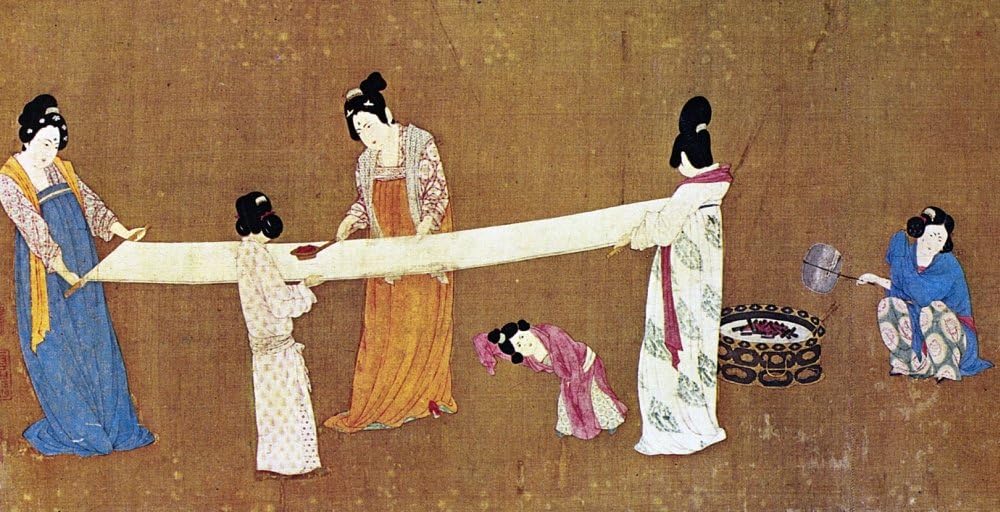
The earliest archaeological evidence of silk in China dates back more than 8,000 years. Silk protein has been identified at Neolithic sites including Jiahu in Henan, while later discoveries provide evidence of silk cultivation and textile production during the Yangshao period. One of the earliest surviving examples of woven silk dates to approximately 3630 BC, from a Yangshao cultural site in Henan.
These discoveries are significant because they demonstrate that silk was not a relatively late invention of imperial China. The foundations of sericulture and silk production developed thousands of years before the great trading empires of the ancient world.
According to Chinese tradition, the discovery of silk is associated with Leizu, the legendary wife of the Yellow Emperor. One well-known story tells of a silkworm cocoon falling into her tea and unraveling into a long filament. The story is legendary rather than historical, but Leizu became an enduring figure in Chinese culture associated with sericulture.
The actual production of silk was anything but simple.
High-quality silk requires the cultivation of suitable mulberry trees, careful breeding and raising of domesticated silkworms, harvesting of cocoons, reeling of extremely fine filaments, and subsequent processes of twisting, weaving, dyeing, and finishing. The combination of biological knowledge and specialized textile craftsmanship made silk one of the most sophisticated materials of the ancient world.
Silk, Status, and the Chinese Economy
Silk initially had strong associations with the Chinese court and elite society. Over time, its use expanded across different levels of Chinese society, but its value remained considerable.
Silk was prized for its distinctive sheen, softness, light weight, strength, and ability to take dyes exceptionally well. It could be transformed into clothing, ceremonial textiles, decorative objects, and eventually even writing material.
In different periods of Chinese history, silk also served functions beyond clothing.
It could be used as a medium of payment, a form of taxation, official remuneration, diplomatic gift, and a tool for political exchange. Its high value relative to its weight made it particularly useful for transferring wealth over long distances.
This economic importance helped make silk an important part of China’s state and commercial systems long before modern currency and banking existed.
The Chinese Silk Secret
For centuries, Chinese silk-making techniques were closely guarded.
The production of silk depended on knowledge that was difficult to reproduce without experience — from cultivating mulberry trees and raising silkworms to harvesting and reeling the cocoons. Chinese states and producers had strong incentives to protect this knowledge and maintain their advantage in silk production.
As silk began to circulate beyond China, knowledge about its origins became surprisingly limited in the Western world.
Ancient Roman writers knew silk as a highly desirable luxury, but some had only vague ideas about how it was produced. The Roman author Pliny the Elder described the Seres, or people associated with the land of silk, while earlier Roman and Greek traditions sometimes imagined silk as a material derived from trees rather than from silkworm cocoons.
The mystery surrounding Chinese silk added to its prestige.
It was not simply an expensive fabric. To distant consumers, it represented a product from a faraway civilization whose manufacturing techniques were largely unknown.
Chinese Silk and the Silk Road
Chinese silk reached distant markets remarkably early.
Silk has been discovered in an Egyptian mummy burial dating to approximately 1070 BC, demonstrating that silk was reaching regions far beyond China centuries before the classical Silk Road trade networks were fully established.
Long-distance trade expanded significantly during the Han dynasty, when China’s connections with Central Asia became increasingly important.
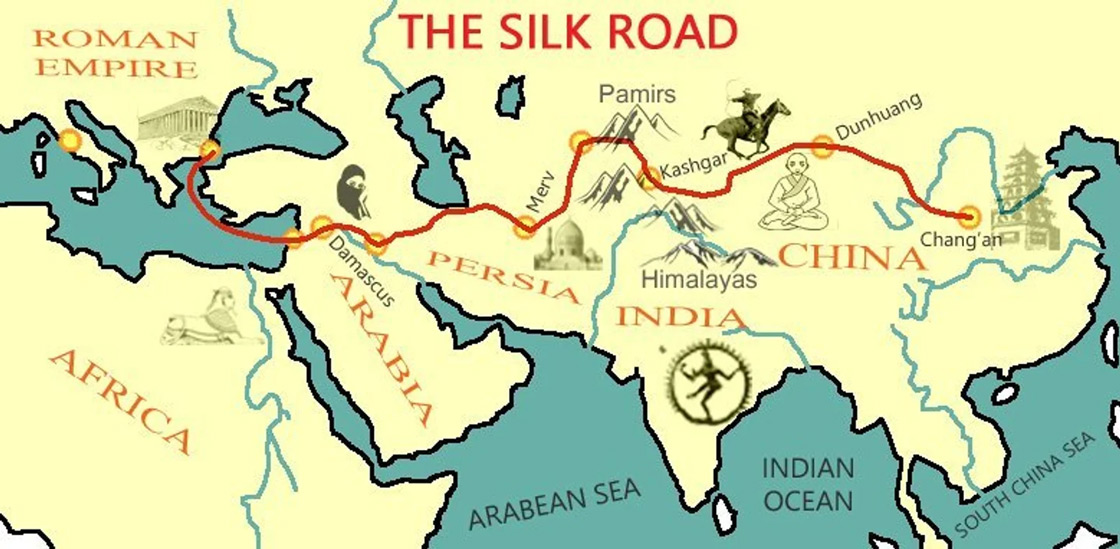
The network now commonly known as the Silk Road was not a single road. It was a changing system of interconnected land routes, caravan trails, oasis cities, and commercial centers stretching across Central Asia and into Persia and the Mediterranean world.
Merchants rarely traveled the entire distance from China to Europe. Instead, goods typically passed through multiple intermediaries, changing hands in major trading centers along the way. Sogdian, Persian, Indian, Arab, and other merchants all played important roles in different periods.
Chinese silk was one of the most important and recognizable commodities moving through these networks.
But silk was never the only product.
Spices, precious stones, glassware, metals, horses, perfumes, medicines, textiles, and other goods traveled in different directions. Alongside merchandise, technologies, artistic styles, languages, religious traditions, and ideas also moved across Eurasia.
The Silk Road was therefore not simply a trade route for silk.
It was one of the world’s great networks of commercial and cultural exchange.
Why Chinese Silk Became So Valuable in Rome
Few examples demonstrate the international importance of Chinese silk better than its reception in the Roman world.
Roman elites developed a strong appetite for silk from the East. Its lightness, translucency, softness, and visual qualities made it an exceptionally desirable luxury.
The popularity of silk also created economic and moral concerns in Rome. Roman writers complained about the wealth flowing eastward to purchase luxury goods, while attempts were made at different times to restrict the use of silk clothing.
The Roman fascination with silk illustrates an important feature of the ancient China silk trade: the value of silk was not limited to its practical function as clothing.
It had become a luxury commodity whose price reflected rarity, craftsmanship, status, and the extraordinary distance over which it traveled.
More Than Silk: A Network of Exchange
The Silk Road’s historical importance ultimately extends far beyond the silk trade itself.
Buddhism traveled from India into Central and East Asia along interconnected trade and pilgrimage routes. Artistic traditions moved between China, Central Asia, Persia, India, and the Mediterranean. Textile designs, technologies, crops, foods, and scientific knowledge crossed cultural boundaries.
Silk was one of the products that helped sustain these commercial connections.
This is why the history of Chinese silk is also part of the history of Eurasian civilization.
The trade did not simply move Chinese products westward. China itself absorbed influences from the societies with which it traded.
The resulting cultural exchange can be seen in Chinese art, textiles, architecture, religion, fashion, and material culture.
From the Silk Road to Maritime Trade
The history of Chinese silk did not end with the decline of the traditional overland routes.
Maritime commerce gradually became increasingly important, linking Chinese ports with Southeast Asia, India, the Persian Gulf, the Red Sea, and East Africa.
Chinese silk became part of the wider maritime trading system of the Indian Ocean and South China Sea. Ports became places where Chinese products were exchanged for goods from across Asia and beyond.
During the early modern period, Chinese silk also became part of trans-Pacific commerce.
Through the Manila Galleon trade, Chinese silk and other Asian goods traveled from the Philippines across the Pacific to Mexico and the Americas, where they entered broader networks connecting Asia, Europe, and the New World.
The history of Chinese silk had therefore expanded from regional and Eurasian commerce into an increasingly interconnected global economy.
Why Is It Called the Silk Road?
There is another interesting detail about the history of Chinese silk: the ancient merchants themselves did not call their routes the “Silk Road.”
The term is modern.
The German geographer Ferdinand von Richthofen used the German term Seidenstraße in the nineteenth century. It was subsequently adopted and popularized as the English “Silk Road.”
The name endured because silk was such a distinctive commodity associated with China’s long-distance trade.
Yet the historical reality was much more complex than the name suggests.
There were many routes rather than one road, many merchants rather than one trading system, and many commodities rather than silk alone.
Chinese Silk in the Modern Era
The nineteenth and twentieth centuries brought profound changes to China’s silk industry.
Industrialization introduced new machinery, transportation systems, commercial institutions, and international markets. Traditional silk production increasingly became connected to modern manufacturing and export networks.
Shanghai played an especially important role in this transformation.
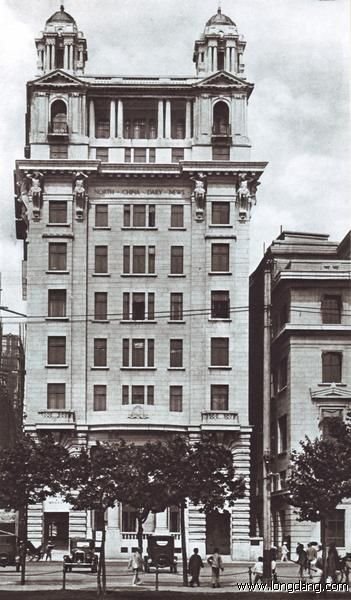
As a major commercial port and industrial center, Shanghai developed close connections between China’s textile production and international markets. Its shipping infrastructure, commercial institutions, financial services, and growing manufacturing base helped make the city an important center for China’s modern textile and apparel trade.
The history of Chinese silk was gradually becoming part of the history of a much larger textile industry.
From Silk to Modern Textiles
Over the twentieth century, China’s textile economy expanded far beyond silk.
Cotton, wool, linen, rayon, synthetic fibers, knitted fabrics, woven fabrics, dyeing, printing, and garment manufacturing all became increasingly important.
This transformation changed the meaning of China’s role in the global textile industry.
China was no longer simply a producer of a famous luxury material.
It was developing the capabilities to manufacture textiles and garments at every stage of the supply chain, from raw materials and fabrics to finished apparel.
The modern Chinese textile industry therefore represents an evolution rather than a break with the country’s silk tradition.
The knowledge accumulated through centuries of textile production — craftsmanship, weaving, dyeing, material development, and international trade — became part of the foundation for a much broader manufacturing industry. Today, China remains the global leader in clothing manufacturing and textile production.
 The Modern Continuation: Shanghai Silk Group
This historical evolution provides the background for the development of Shanghai Silk Group.
Shanghai Silk Group traces its corporate heritage to 1949, following the establishment of its predecessor, China Silk Corporation, in Shanghai in 1946 under the Nationalist government. Over the decades, the company evolved from a traditional textile and apparel trading enterprise into an integrated organization encompassing design, textile research and development, sourcing, manufacturing, quality testing, sales, and brand operations.
The company therefore represents one example of how China’s historic textile trade developed into the modern apparel industry.
While silk remains part of its heritage, Shanghai Silk’s contemporary business extends across a much broader range of textile and apparel activities, including fabric development, garment manufacturing, sourcing, production management, and international trade.
The Group has also developed its own fashion brand, LILY, which was launched in 2000 and built around contemporary women’s business fashion. The brand has since expanded across China and into international markets.
The transformation can be summarized simply:
Silk → Textiles → International Trade → Manufacturing → Global Supply Chains → Fashion Brands
The Enduring Legacy of China Silk
The story of China silk is ultimately a story of continuous evolution.
It begins with ancient knowledge of the silkworm and the mulberry tree.
It continues through thousands of years of craftsmanship, domestic production, luxury consumption, and international commerce.
It passes through the overland Silk Roads and maritime trading networks that connected China with distant civilizations.
And it eventually becomes part of the modern global textile and apparel industry.
Silk was one of China’s earliest globally recognized products.
But its greatest legacy may be something larger than the fabric itself.
It helped establish a tradition of connecting Chinese textile craftsmanship with the wider world.
Today, that tradition continues in many forms — from silk and other advanced fabrics to modern garment manufacturing, international sourcing, fashion brands, and global supply chains.
The story that began with the ancient Chinese silkworm has never really ended.
It has simply evolved.